
A book about the question before the answer

What Are
We Missing?

Smart people. Good information. The wrong decision. What happens in the gap between evidence and judgement?

For managers, founders, clinicians, engineers - and everyone whose call other people live with.

Zafar Alam  /  Planned for 13 February 2027

Aviation, energy, space, construction. Different industries, the same missed question - open a room:

All four are in the public record - see what the 473 works behind the book are made of ▾

The premise

It wasn't a lack of information.

A decision can fail even when the facts are already on the table. This book asks what keeps a person, a team, or an institution from seeing what those facts mean together.

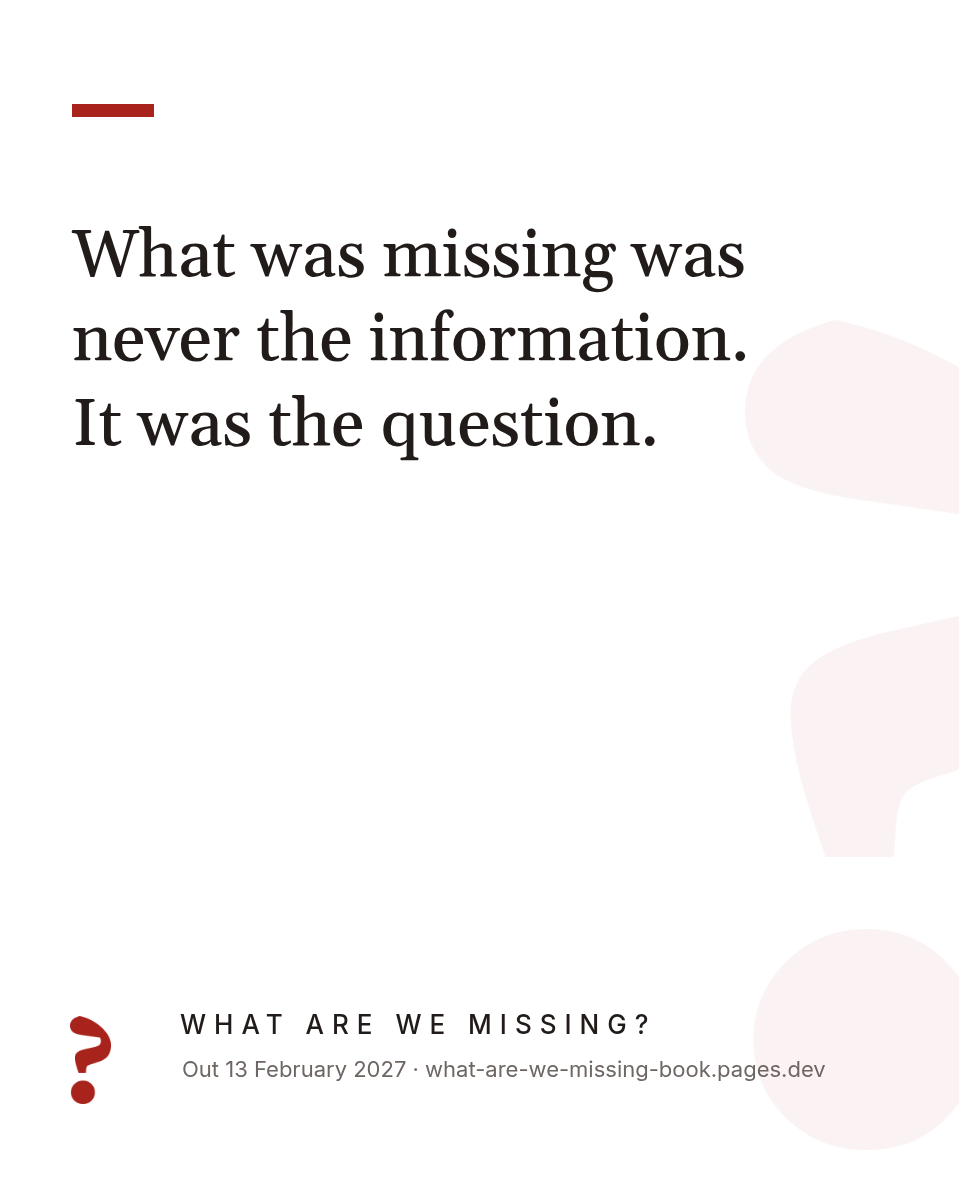
“What was missing was never the information. It was the question.”
From the preface, What Are We Missing?

01 / The problem

Seven rooms.
One missed question.

Real cases in the book. These are entry points, not the whole account.

01 / Macondo, 2010

Deepwater Horizon

The test readings were anomalous. What made experienced people read them as acceptable?

The missing check

In the book, Macondo runs through PRISM: warnings were given local explanations, but nobody assembled the full picture.
How the book works ↓
02 / The launch, 1986

Challenger

Engineers warned against launch in the cold. Then the room changed what counted as proof.

The missing check

The burden shifted from “show it is safe to fly” to “show it will fail” in conditions never flown before.

How the book works ↓
03 / The crashes, 2018-19

Boeing 737 MAX

A system the pilots were never told about pushed the nose down. Two planes fell. 346 people.

The missing check

In the book: why a room of capable people can sign off on a wrong call - and what stops it.

How the book works ↓
04 / Silicon Valley

Theranos

Prestige and a nine-billion-dollar valuation met one question too few: did the device actually work?

The missing check

The board’s prestige was not a substitute for expertise in medical testing. The book examines the halo effect and the evidence that went untested.

How the book works ↓
05 / The test, 2015

Volkswagen

The cars knew when they were being tested, and performed accordingly. Eleven million of them.

The missing check

In the book: what a cheating car reveals about what we choose to value.

How the book works ↓
06 / The crisis, 2008

The financial crash

What happens when a model seems to work for decades, and the world has changed beneath it?

The missing check

Alan Greenspan told a 2008 hearing he had found “a flaw in the model.” The book asks what a strong mind overlooks when its assumptions go untested.

How the book works ↓
07 / The contrast, 1982

Tylenol

Seven people died from poisoned capsules. The company asked the question fast, and pulled 31 million bottles from the shelves.

The missing check

The book’s contrast case: judgement under pressure is not doomed - the values had been committed decades before the crisis.

How the book works ↓

Beyond the book

Carillion, 2018: a British construction giant, audited and signed off to the end, liquidated with billions owed. Not a case in the book - the same missed question, in the author’s own industry.

The Macondo series

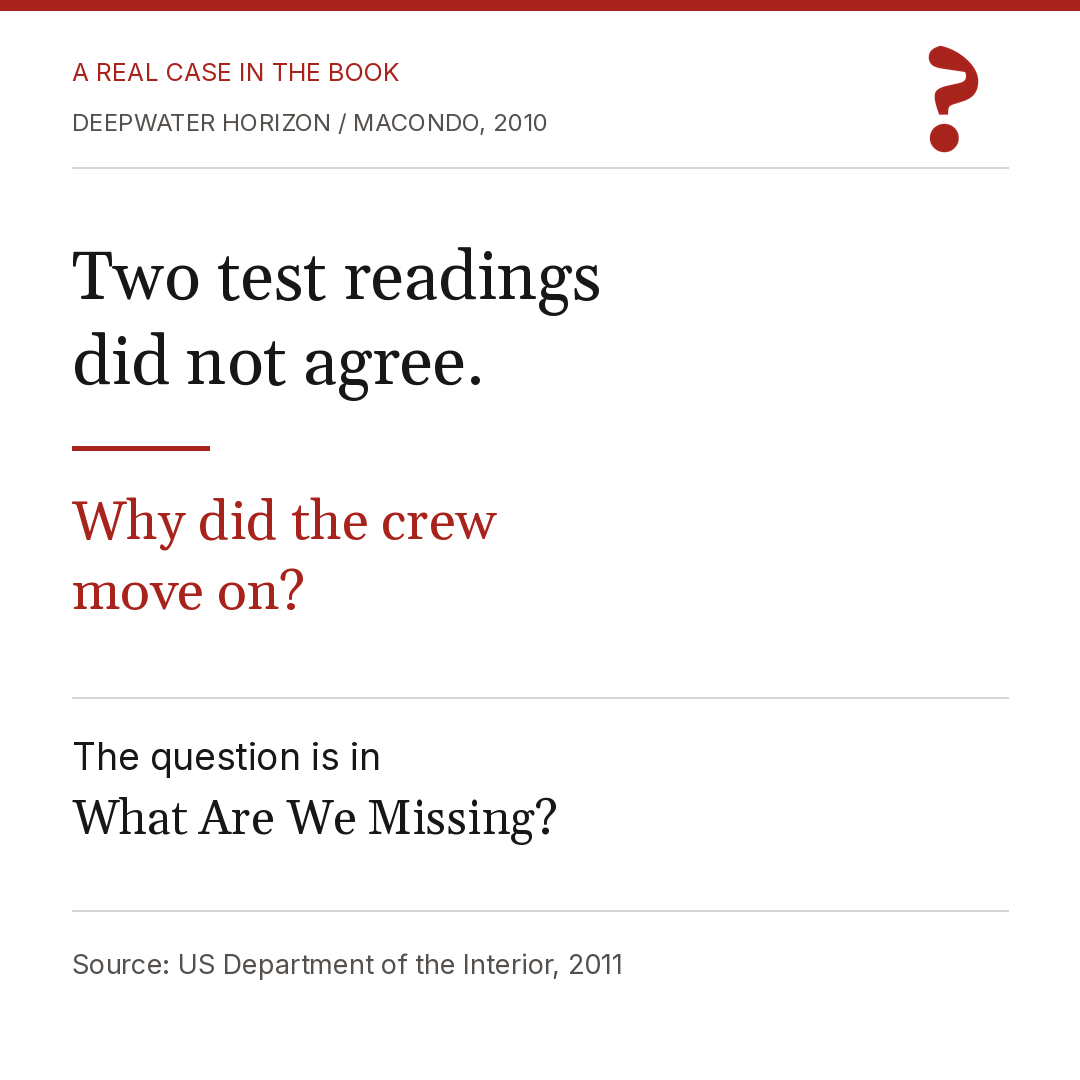
Card: Two test readings did not agree. Why did the crew move on? Deepwater Horizon, Macondo, 2010.

Deepwater Horizon: before the blowout, the negative-pressure test showed a serious pressure difference between the drill pipe and kill line. The Interior Department’s investigation says the crew accepted an explanation later found to be unfounded, judged the test successful and continued temporary-abandonment work. It was one decision in a disaster with several causes.

Why did the crew move on when the readings did not agree? I examine that question in What Are We Missing?

Source: US Department of the Interior, Oil Spill Investigation testimony (2011) ↗

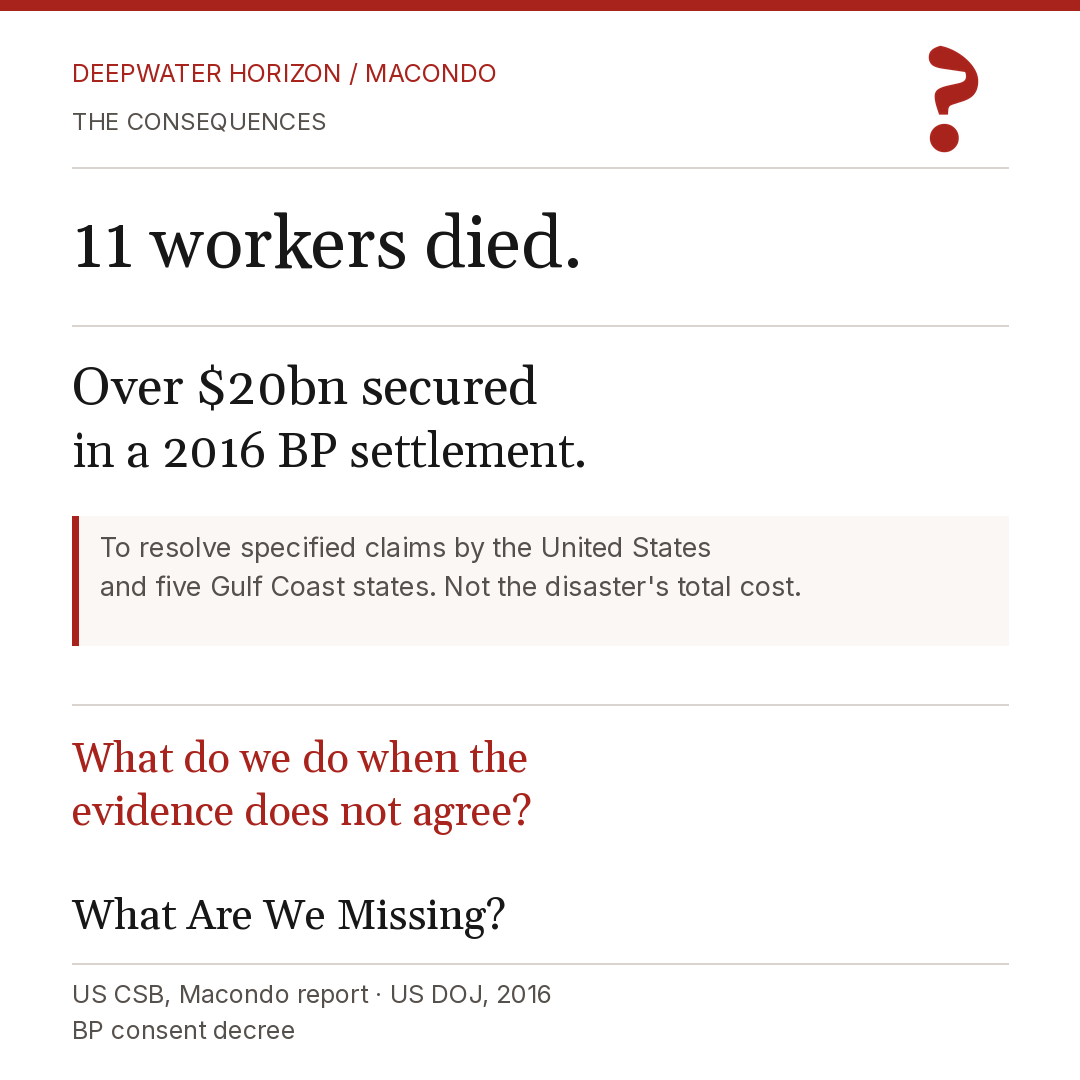
Card: 11 workers died. Over $20bn secured in a 2016 BP settlement. Deepwater Horizon, the consequences.

Deepwater Horizon killed 11 workers. In April 2016, a consent decree secured more than $20 billion in BP settlement obligations to resolve specified claims by the United States and five Gulf Coast states. That figure is not the disaster’s total economic cost, and it cannot measure the loss of life.

When the evidence does not agree, what do we do next? What Are We Missing? looks at decisions like this and ways to test them more carefully.

Sources: US Chemical Safety Board, Macondo Blowout and Explosion ↗ · US Department of Justice, 2016 BP consent-decree account ↗

The quiet gaps

The failures that make no noise.

Big failures get commissions and transcripts. Most gaps in thinking are quieter - a headline, a price tag, a room in agreement. Three cards in the book’s design, free to download and post.

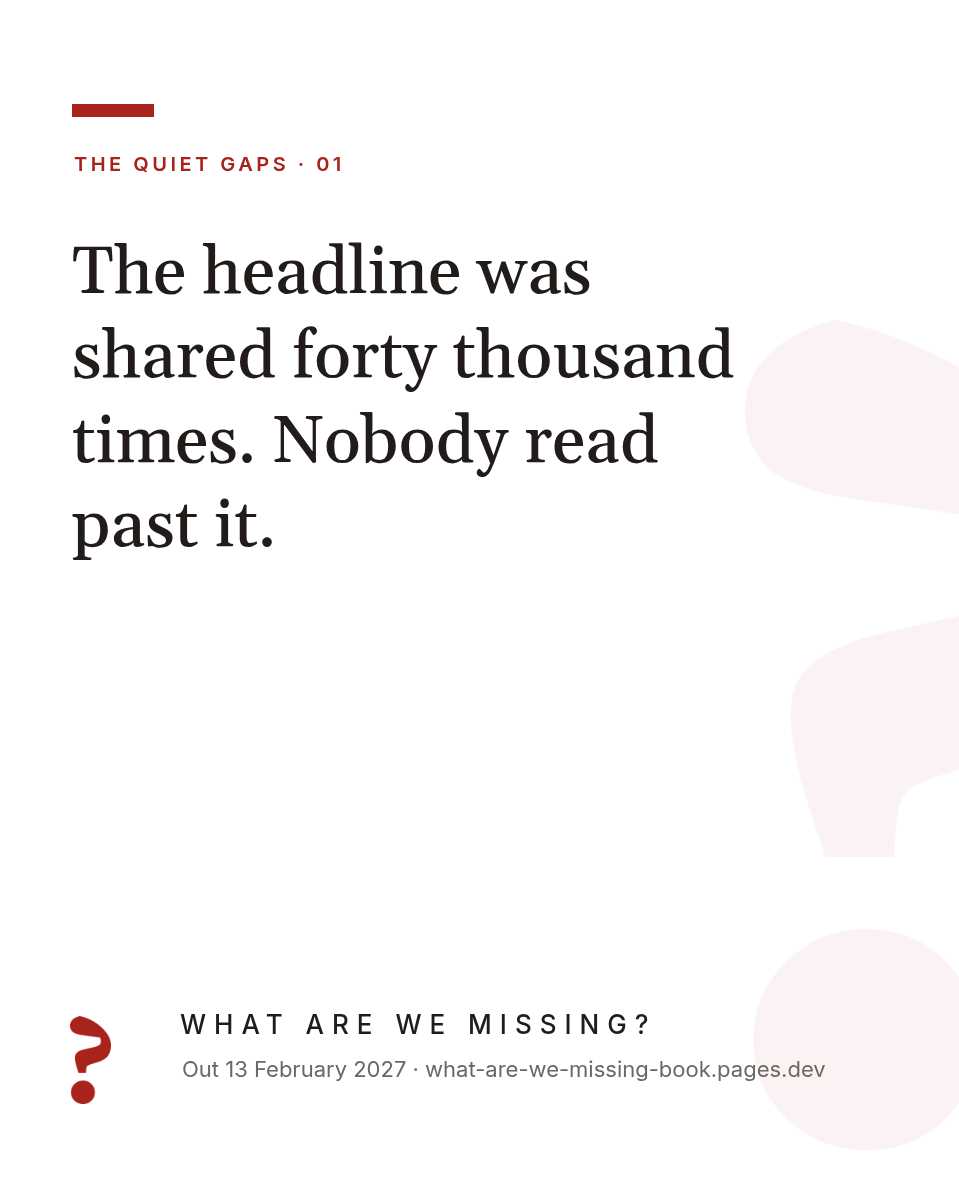
Card: The headline was shared forty thousand times. Nobody read past it.
01 / The headline. Shared forty thousand times. Nobody read past it.
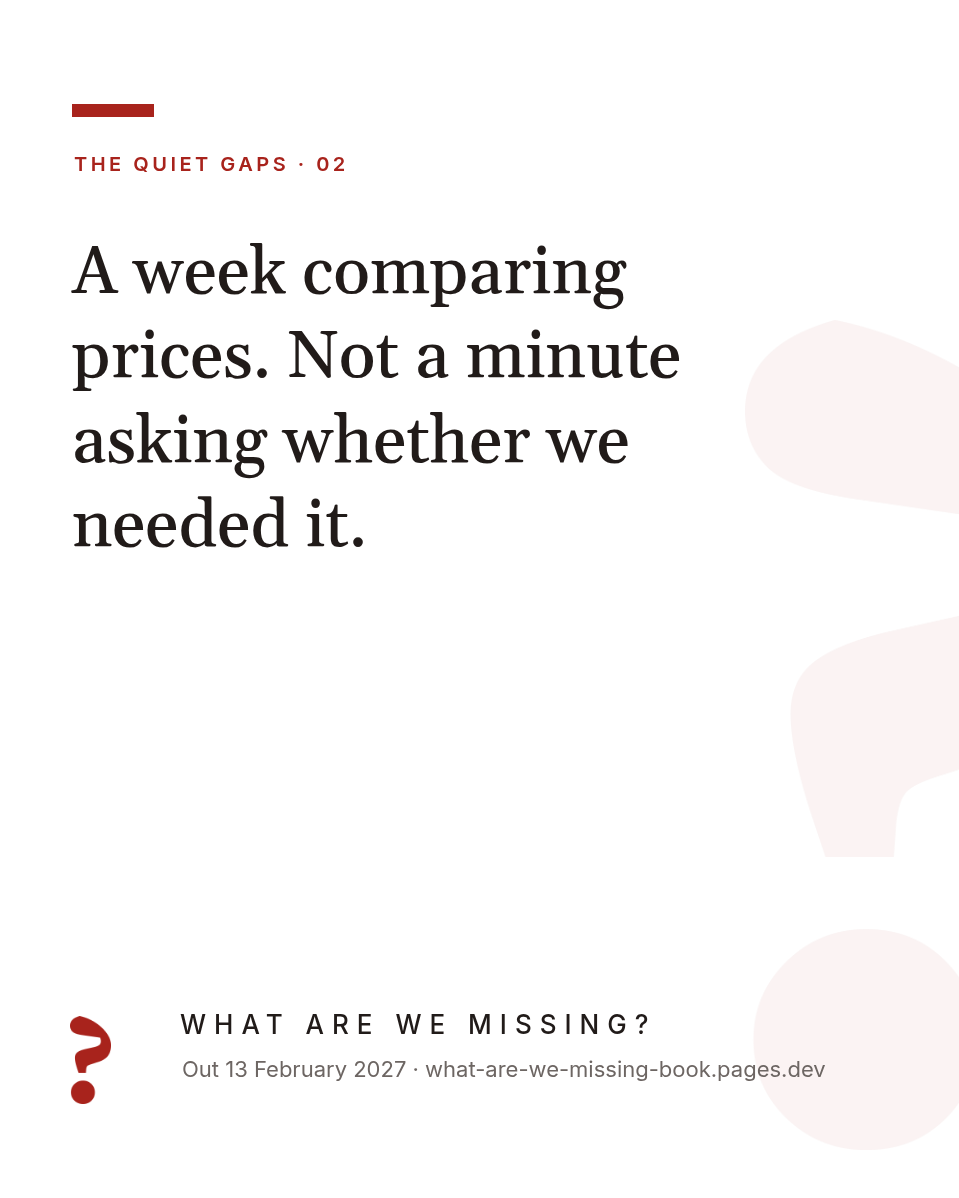
Card: A week comparing prices. Not a minute asking whether we needed it.
02 / The purchase. A week comparing prices. Not a minute asking whether we needed it.
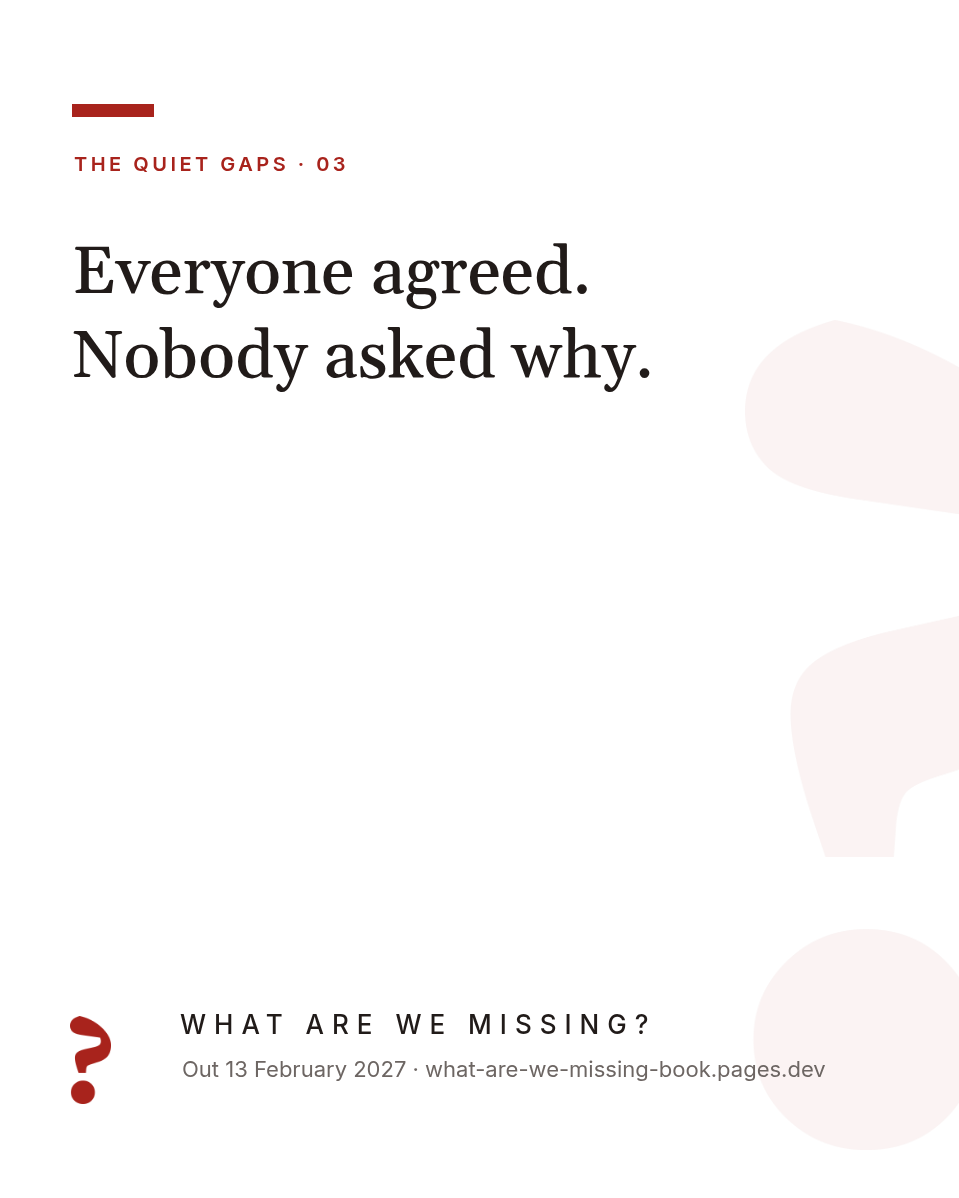
Card: Everyone agreed. Nobody asked why.
03 / The agreement. Everyone agreed. Nobody asked why.

02 / The lens

Meet PRISM.

Five moves. Four in sequence; one watching over them all. Select a letter to look closer.

P / 01

Problem Framing

Are we solving the right problem?

When solutions arrive before the problem is agreed, the answer may be precise and still be wrong.

PRISM is the author's synthesis of tested parts, not a separately validated model. Explore the framework in full in the book.

03 / Try the method

Five questions. One decision.

Take a decision sitting on your desk right now. Run it through PRISM - one question per move. Be honest; nobody sees the answers but you.

Try it now

Run your own decision through PRISM.

Type a decision sitting on your desk, then walk it through all five moves in your own words. At the end, PRISM lays your run back out for you. Nothing is stored; nothing leaves this page.

The decision

What is sitting on your desk?

One sentence is enough. PRISM will walk it through its five moves with you, one move at a time.

P / 01 - Problem framing

Are we solving the right problem?

This move slows the start down: say the problem plainly before any solution gets a hearing. When solutions arrive before the problem is agreed, the answer can be precise and still be wrong.

R / 02 - Research

What would prove you wrong?

This move sends you looking for the uncomfortable evidence on purpose, not the comfortable kind. The search fails when it stops at the wanted answer.

I / 03 - Interpretation

What else could this mean?

This move gives the second explanation a fair hearing before the first one wins. The first story that fits is not always the true one.

S / 04 - Synthesis

What do all the pieces say together?

This move lays every piece on one table and reads the pattern across them. Fragments that look fine alone can say something else together.

M / 05 - Metacognition

How confident should you be - and what are you missing?

This move watches the other four. Confidence gets a number, and the number gets questioned. It is the move that asks the whole run whether it was honest.

Your PRISM run

This is your own thinking laid back out. PRISM does not check it for you - what you do with it is still yours.

Five moves, walked in your own words. The judgment stays yours - the full practice is in the book.

“Nobody asked what they were missing.”

From the preface, What Are We Missing?

Zafar Alam, author of What Are We Missing?

04 / About the author

Built on real decisions.

Zafar Alam is a civil engineer and Chartered Construction Manager with the CIOB. He spent twelve years delivering major infrastructure and energy projects in the UK and the Middle East, leading subcontractor teams on site. He began writing this book in 2021, after years of watching capable people with good information still fail to decide.

For review or interview enquiries, email zafaralam.author@gmail.com.

Email inquiries ↗LinkedIn ↗

Already published

The Cognitive Crisis in AI-Augmented Work

A published paperback about human judgement and AI. ISBN 979-8241450630.

View on Amazon ↗

05 / Why this book

Before you decide
to read.

Most books about thinking tell you that smart people err. This one starts where they stop: what to do in the minutes before your own decision hardens.

The preface, in brief

The question on the cover came from work.

Zafar is a civil engineer. On major projects, he watched capable people with good information make decisions that failed in the gaps between teams. He began writing in 2021 to find a better way of asking questions before a decision hardens.

His opening case is Deepwater Horizon. An anomalous test was interpreted as acceptable; eleven men died. The book does not treat that as a failure of intelligence. It asks how the evidence was read, how a room handled doubt, and how to make the missing question easier to ask in time.

The promise is a discipline, not certainty. PRISM is a working route through the problem, the evidence, the interpretation and the decision, with a check on your own confidence throughout. You read it once; you run it for the rest of your working life.

It was written for the world you actually decide in now. A machine will draft your analysis, summarise your evidence and offer its confidence for free. Doctors who read scans for a living grew measurably worse when a machine's wrong answer arrived wearing confidence. The oldest problem in judgment has met its newest amplifier, and this book was built with that amplifier already in the room.

And it was written to be used, not admired. Every chapter closes in protocols: small, deliberate practices you can run at your desk, in the meeting, in the small hours when the answer looks obvious. Understanding a failure has never prevented one. Practice does.

The reading path

  1. 01 / Inside the mindWhy thought runs fast, what it notices, and where it errs.
  2. 02 / Inside the roomHow teams and institutions change what counts as evidence.
  3. 03 / Beside the machineWhat happens when AI can produce a confident answer for you.

Cases return at a wider scale instead of appearing once and disappearing, because a lesson is learned only when it survives a change of level.

What you walk away able to do

  1. Frame the real problemBefore solving, test whether you are solving the right question at all.
  2. Read evidence against yourselfRun your preferred conclusion against the record, not alongside it.
  3. Catch yourself being wrongCalibrated confidence: know where your knowledge ends, before the decision finds out.
  4. Make the room hear the warningWhat decides whether doubt gets spoken, and what rooms do with what they hear.
  5. Decide beside the machineWhen to trust a fluent AI answer, when to verify, and how to keep the judgment yours.

06 / What this does well

More than a list
of biases.

The shelf of books about thinking is full of good accounts of error. What is missing from that shelf is a working discipline. Four things this book delivers that the catalogue does not.

01

One framework, not a hundred effects

Most thinking books hand you a catalogue of biases to admire. This one gives you a single route: Problem Framing, Research, Interpretation, Synthesis, with Metacognition standing over them all - the five moves every sound judgment requires, each made trainable. You can run PRISM before a decision, in the meeting, and revisit it when new evidence changes the picture. It is the author's synthesis of tested parts, not a separately validated model, and it says so.

02

Cases on the record, not anecdote

Deepwater Horizon, Challenger, Theranos, the financial crisis, a hospital without an interpreter, three and a half minutes over the Hudson. The cases draw on official commissions, hearing transcripts, court records, journalism and the companies’ own accounts. Where the evidence is young or contested, the text says so on its face, and the author's interpretation is kept separate from the source. What the 473 works behind the book are made of ▾

03

Practice that transfers

Reading about error has never, by itself, prevented it. So every chapter closes in protocols: small deliberate practices built for near transfer, the kind you can run this week in your own work and keep running until the move is yours. The point is not to recognise a failure after it happens. It is to ask the missing question in time.

04

Built for the AI era, not retrofitted to it

Most books on thinking were written before a machine could answer questions you never asked, in prose more confident than most experts. This one began with that machine in the room: what thinking means once thinking can be outsourced, why experts defer to confident wrong answers, and what stays yours. Its own production discloses AI assistance and the author's checking and decisions.

For readers whose decisions carry weight. Managers, founders, clinicians, engineers, analysts and anyone whose choice affects someone else. You do not need specialist training; you do need to be willing to question an answer that feels settled.

473Works drawn onThe research behind the argument - the edition currently in review.
594EndnotesThe sources, on the page, behind the argument.
15ChaptersOne question, run through the mind, the room and the machine.

What those 473 works are made of ▾

The reading behind it

One book. A library behind it.

This is not one man's opinion stretched over chapters. The edition in review draws on 473 works - official commissions, hearing transcripts, peer-reviewed research, investigations and books - read across five years; figures describe the edition in review and may change before publication. The 594 endnotes put the sources on the page, so you never have to take the author's word for anything.

473 works behind the bookClick a branch - verified against the public record
OfficialCommissions and inquiry reports - the record, not the retelling.
On the recordWhat the settlements and proceedings documented.
ResearchPeer-reviewed work on judgement, bias and decision-making.
The full listThe complete source list, free.
What Are We Missing? cover, with a red question mark on white

07 / Forthcoming book

The question is the beginning.

What Are We Missing? How to Think More Clearly Before You Decide is in final author review - current status and date ▾

T-minus to the planned launch / 13 February 2027

–Days
–Hours
–Minutes
–Seconds
Follow the progress

Inside the book

Fifteen chapters.
One question.

See all fifteen chapters
  1. 01

    The Foundations of Critical Thinking

    Delivers the critical foundation - teaches you how to think, and what failure looks like when nobody asks.

  2. 02

    The Machinery of Thinking

    Delivers the machinery - how your mind actually runs under pressure, and where it can be trained.

  3. 03

    The Bugs in the Machinery

    Teaches the built-in bugs no intelligence escapes - why the smartest minds backed Theranos.

  4. 04

    What the Machine Eats

    Teaches what feeds the machines now feeding you answers - and what that diet does to your own thinking.

  5. 05

    The Right Tool for the Job

    Teaches you to match the method to the problem before you start.

  6. 06

    Deciding What Matters

    Teaches you to decide what actually matters - a car that knew when it was being tested, and what it reveals about what we choose to value.

  7. 07

    Experience Is Not the Teacher

    Teaches why experience alone repeats mistakes - and what real learning takes instead.

  8. 08

    Whether the Room Will Let You Say It

    Teaches you to read the room before you speak - two rooms, thirty-three years apart, and the warning neither could hear.

  9. 09

    What the Room Does With What It Hears

    Teaches what organisations do with what they hear - and how to keep knowledge alive inside one.

  10. 10

    Building Critical Thinking Habits

    Delivers the daily practices that turn method into habit - because understanding a failure never prevented one.

  11. 11

    Integrated Decision Architecture

    Delivers the whole toolkit as one architecture you can run before any decision.

  12. 12

    Group Judgment and Failure Prevention

    Teaches you to stop a table of smart people signing off on a wrong call.

  13. 13

    Ethics, Cultural Intelligence, and Moral Reasoning in Critical Thinking

    Teaches you to think differently, not harder, when two coherent worldviews collide.

  14. 14

    Critical Thinking in the AI Era

    Teaches you to keep thinking when thinking can be outsourced - experts grew worse when a confident machine answered first.

  15. 15

    The Last Choice - Sovereignty in the Age of Machines

    Delivers the endgame - three waves brought us here; the last choice is who does the thinking.

Chapter titles from the edition currently in review. The teasers whet; the chapters deliver.

08 / The facts

What you need
to know.

No inflated promises. Here is the book's current status and the method behind it.

Title
What Are We Missing? How to Think More Clearly Before You Decide
Author
Zafar Alam
Status
In final author review. Not available to order yet.
Planned date
13 February 2027 Subject to final author approval and publishing route.
Scope
Fifteen chapters - the full list ↑
Source record
The edition in review draws on 473 works and 594 endnotes. What they are made of ▾
How it was made
AI assisted with gathering, testing arguments, facts and writing. The author checked the work; the reading, judgement and decisions stayed his.
Price and format
Not announced. No purchase link for this book until a real listing exists.

Still deciding?

Start with the five PRISM questions above. If a repeatable practice, source-checkable cases and a clear account of AI's role matter to you, follow the book while Zafar completes his final read.

Follow the book ↗

09 / Questions

Asked and
answered.

Everything a reader asks before picking up this book. Missing something? Email zafaralam.author@gmail.com.

THE BOOK
Why should I read this book?

Because decisions still fail the same way they always have - smart people, good information, the question nobody asked. This book is built for the minutes before your own decision hardens: it gives you a working route through the problem, the evidence, the interpretation and the decision, with a check on your own confidence throughout.

Who is it for?

Anyone whose work ends in a decision - managers, engineers, doctors, founders, students, teams. If a machine now drafts your analysis and summarises your evidence, it was written with you already in the room.

What is it about, in one line?

What happens in the gap between evidence and judgement - and how to ask the missing question in time.

What is PRISM?

The framework the book teaches: five moves - Problem Framing, Research, Interpretation, Synthesis - with Metacognition standing over them all. See it in full ↑ or run a decision through it ↑.

How is it different from other books about thinking?

Most thinking books hand you a catalogue of biases to admire. This one gives you a single route you can actually run, cases from the public record instead of anecdotes, and protocols - small deliberate practices - at the end of every chapter, because understanding a failure has never prevented one.

Will this book stop me making bad decisions?

No honest book can promise that, and this one does not. The promise is a discipline, not certainty: a repeatable practice that makes the missing question easier to ask in time.

Is it a self-help book?

It is a working discipline, not motivation. The opening case is an oil rig, not an affirmation.

Do I need a background in psychology or science?

No. The machinery of thinking is explained plainly, and every technical claim carries a source you can check.

How is the book organised?

Fifteen chapters in three movements - inside the mind, inside the room, beside the machine. The reading path ↑

What will I walk away able to do?

Five things - from framing the real problem to deciding beside the machine without handing the judgment over. The full list ↑

19 more questions - the evidence, the author, the practical, the comparisons
THE EVIDENCE
Are the cases real?

All of them. Deepwater Horizon, Challenger, Theranos, the 2008 financial crisis and more - drawn from the public record: official commissions, hearing transcripts, court records, journalism and company accounts. The sources ↑

How well researched is it?

The edition in review draws on 473 works with 594 endnotes - see what they are made of ↑. Where evidence is young or contested, the text says so on its face.

Is PRISM scientifically proven?

It is the author's synthesis of tested parts, not a separately validated model - and the book says so openly. The parts come from published research; the route through them is his.

What does AI have to do with judgement?

A machine will now draft your analysis and offer its confidence for free. Experts who read scans for a living grew measurably worse when a machine's wrong answer arrived wearing confidence. The oldest problem in judgement has met its newest amplifier; the book was built with that amplifier already in the room.

THE AUTHOR
Who is Zafar Alam?

A civil engineer and Chartered Construction Manager who spent years managing national-infrastructure projects in the Middle East before moving to the UK. He began writing this book in 2021.

Why did a construction manager write a book about thinking?

Because on projects that size he watched the same failure repeat: capable people, good information, and decisions that failed in the space between teams - for want of one question asked in time. Five years of taking that problem apart became this book.

Has he written anything else?

Yes. The Cognitive Crisis in AI-Augmented Work - on how human judgement erodes when technology assumes cognitive tasks - is published and available now in paperback and Kindle.

PRACTICAL
When does the book come out?

Planned for 13 February 2027, subject to final author approval and the publishing route. The facts ▾

Can I read a sample first?

Yes - a free sample with the cover and the preface is in the downloads section below. Enough to know if the book is for you, and nothing more.

How much will it cost?

Not announced yet. There is no purchase link until a real listing exists - no exceptions.

How do I follow the book's progress?

Follow the author on Instagram (@whatrwemissing) or the book on X (@WhatAreWMissing), or check the news section below - it only carries dated, verifiable updates.

Can I share quotes from the book?

The downloads section below has free quote cards, in the book's own design, made for posting on your own channels. That is what they are for.

I'm a reviewer or journalist - how do I get in touch?

Email zafaralam.author@gmail.com. Independent reviewers and review channels have been asked; nothing has come back yet. Every genuine endorsement will appear on this site exactly as sent, with the reviewer's name.

Is it useful for teams, not just individuals?

Deliberately so. Two of the fifteen chapters are about the room itself - why a table of smart people can sign off on a wrong call, and what decides whether doubt gets spoken out loud.

COMPARISONS
How does it compare to Thinking, Fast and Slow?

Kahneman's book is the landmark account of why the mind errs - the two systems, the biases, the decades of evidence. What Are We Missing? starts where that shelf stops: what to do in the minutes before your own decision hardens. One route to run rather than a catalogue to admire - and the room and the machine are in it too.

How is it different from The Art of Thinking Clearly?

Rolf Dobelli's book is a field guide: ninety-nine short chapters, one thinking error each. This book is the opposite shape - a single framework, PRISM, that you run before any decision, with protocols at the end of every chapter that turn the moves into habit.

What about Noise?

Noise, by Kahneman, Sibony and Sunstein, is about unwanted variability - why the same question gets different answers from different judges - and its remedy, decision hygiene, is aimed mainly at organisations. What Are We Missing? works one step earlier: whether the question being answered is the right one at all, for a person, a room, or a machine.

And Superforecasting?

Tetlock and Gardner studied people who are measurably best at predicting events: they update often, think in probabilities, keep score. This book is about the decisions that never get scored - the ones you make once and cannot take back. Same family, different room.

If I read only one, why this one?

Read Kahneman to understand the mind. Read this when the decision is yours and the room has gone quiet. It was built for the world you actually decide in now - with AI already in it.

10 / Recommendations

Out for review,
in the open.

Where this book has gone for independent review, and exactly what has come back. This page is updated as replies land.

From readers

★★★★★
“We always hear about AI taking jobs but Zafar Alam’s journal is the first thing I’ve seen that actually talks about it taking over our minds… he shows with some really solid research how we’re losing that raw thinking power just by offloading the small stuff to apps.”

Sagar Poojary · 5 out of 5 stars · Verified Purchase
Amazon India, 19 January 2026 · reviewing The Cognitive Crisis in AI-Augmented Work (Kindle Edition)

Read on Amazon ↗

Received for this book

Nothing here yet. On purpose.

No endorsements have been received so far. When a reviewer sends words the author may quote, they will appear in this space with the reviewer's name and role, exactly as sent. Until then it stays empty rather than borrowed.

The first received endorsement will be published here.

11 / Under review

In their hands.

The people below have been asked to read the book and say what they think. A name here means the book was sent or handed over - not that the person has read it, and never that they endorse it. What comes back will appear in Recommendations, quoted exactly as sent.

Alan McWilliam

Alan McWilliam

Project Director, BAM - EGL2, Peterhead

A senior project leader in the author’s own industry, reading the book ahead of release.

Handed a hard copy to review, 28 September 2026

Review copy in hand

James McCabe

Senior Planner

A senior planner and an analytical thinker - the reader this book was written for.

Handed a review copy, 28 September 2026

Review copy in hand

Jonathan Haber

Critical-thinking educator

Writes and researches how critical thinking is taught and learned.

Asked 27 September 2026

Reached out to review

Tom Chatfield

Tom Chatfield

Author and broadcaster

Writes on clear thinking, technology and how we reason.

Asked 27 September 2026

Reached out to review

Alex Edmans

Alex Edmans

Professor of finance

Studies how stories, statistics and studies mislead decisions.

Asked 27 September 2026

Reached out to review

Adam Mastroianni

Experimental psychologist

Writes about how minds actually work, from inside the science.

Asked 27 September 2026

Reached out to review

Julia Galef

Julia Galef

Author

Writes about seeing the world clearly and updating beliefs.

Asked 27 September 2026

Reached out to review

Spencer Greenberg

Mathematician and founder

Builds tools for clearer thinking and better decisions.

Sent an advance review copy, 27 September 2026

Copy sent; review pending

David Robson

David Robson

Science writer

Writes on the psychology of judgement and expectation.

Asked 27 September 2026

Reached out to review

Seven further reviewers and book-media channels in India were asked on 27 September 2026. Photos land as they are confirmed.

12 / News

The record
as it happens.

Dated updates: recommendations received, review coverage, milestones. Nothing appears here until it is real and verifiable.

28 September 2026 / Review copies

Advance review copies are out

Advance copies of the current edition are now with named reviewers and domain experts for feedback.

27 September 2026 / Reviewers

Five leading thinkers invited to review the book

Julia Galef, Spencer Greenberg, David Robson, Tom Chatfield and Alex Edmans have been invited to review it. Spencer Greenberg, founder of Clearer Thinking, has been sent an advance review copy.

27 September 2026 / Already out

The Cognitive Crisis in AI-Augmented Work

Before What Are We Missing?, there is a book you can read today. The Cognitive Crisis in AI-Augmented Work is published and available in paperback.

View on Amazon ↗

What lands here next

Recommendations and reviews, when they are real

Fourteen review requests went out on 27 September 2026 - seven expert reviewers and seven Indian review channels. The first genuine replies, endorsements and coverage will be logged here, dated and sourced. Until then, this section stays quiet on purpose.

13 / Downloads

Take it
with you.

Free to download, free to share. The sample gives you the cover and the preface - enough to know if the book is for you, and nothing more.

The cards are words from the book in its own design - download and post them on your own channels; that is what they are for.

14 / Stay close

Get launch updates.

One email at launch. Nothing else. Unsubscribe anytime.

Your address goes to the launch list and nowhere else.

Something went wrong - please try again in a moment.

You're on the list. One email at launch. Nothing else.

15 / The conversation

The questions continue.

Follow the thinking while the book takes shape. Embedded posts depend on each platform's availability and your privacy settings.

16 / Articles

Notes from
the same desk.

Short pieces by the author, in the book’s world - the question before the answer, in everyday decisions.

Live now

The first notes are live.

Short pieces by Zafar Alam, in the book’s world - published on the articles page, dated, newest first.

Open the articles page ↗